
Rebalance the portfolio at least once a year to ensure it remains in sync with the target asset allocation.

Twenty-three of the 31 stocks in his publicly disclosed portfolio consist small-cap stocks. jhunjhunwala's portfolio rose 15.2% in Q3.

rediffGURU Ramalingam Kalirajan answers your personal finance queries.

'We expect market consolidation and recommend buying during market dips.'

Food delivery and quick commerce (qcom) service application (app), Zomato, now commands a market capitalisation (mcap) higher than automobile giants Tata Motors and Bajaj Auto. Zomato, whose shares closed 1.18 per cent lower on Thursday at Rs 288.45 per share, has an mcap of Rs 2.78 trillion, according to BSE data. By comparison, Tata Motors' mcap stood at Rs 2.74 trillion, while Bajaj Auto's was Rs 2.5 trillion on the BSE.

'My advice: Don't mark your portfolio to market every day. Focus on survival.'

Inflow in equity mutual funds halved to Rs 3,240 crore in May, declining for the second consecutive month, primarily due to profit booking by investors amid rising market. However, this was also the 27th consecutive month of inflow in the equity class, which was primarily driven by fund infusion in small-cap and mid-cap categories, data released by the Association of Mutual Funds in India (Amfi) showed on Friday. Overall, the 42-player mutual fund industry continues to see inflow and attracted Rs 57,420 crore, on contributions from debt-oriented schemes.

rediffGURU Vivek Lala answers your income tax and personal finance queries.

Analysts remain bullish on the road ahead for the equity markets, but warn against volatility on account of domestic and global cues. The upcoming Lok Sabha elections back home and the interest rate trajectory of the US Federal Reserve, they said, will be the two most important factors that the markets will keep a tab on. That apart, the valuation of the Indian markets, they feel, will also be eyed in context of how global peers are performing.

Omkeshwar Singh, head, Rank MF, a mutual fund investment platform, answers your queries.

rediffGURU and financial planning expert Colonel Sanjeev Govila (retd) answers your personal finance-related questions.

The rise in consumer price index (CPI) inflation could see the Reserve Bank of India (RBI) in an extended pause mode as regards interest rates, and in turn, keep the market rally in check, believe analysts. Signs of inflation cooling off in the US, however, is likely to provide some cushion as the expectations of a change in stance by the US Fed as regards interest rates is likely to aid sentiment. Back home, CPI inflation surged for the first time in five months to 4.81 per cent in June 2023, and was higher than the street's expectations of 4.58 per cent.

The downslide on Dalal Street did not spare big names in 2011, but small stocks lived up to their nomenclature with a much more sickening slump and investment in mid-cap companies also turned out to be messy affair.

The equity market's recent downturn appears unlikely to slow the brisk pace of mutual fund (MF) scheme launches, at least in the coming weeks. Last month, fund houses introduced 21 new equity schemes, with another five launches already lined up for November. The number of filing with markets regulator, Securities and Exchange Board of India (Sebi), suggests this momentum will continue with asset management companies (AMCs) seeking approval for 21 more equity schemes in October.

If you redeem your investments when prices have fallen sharply, you will be selling at low prices and may make a permanent loss. On the other hand, if you remain patient and remain invested, you give your investment the time to recover, says Dwaipayan Bose

Among major Sensex gainers, Mahindra & Mahindra rose the most by 3.29 per cent. Adani Ports gained 1.26 per cent, Tata Motors by 1.14 per cent, and Axis Bank by 0.92 per cent. Nestle, NTPC, Reliance, ITC Titan, Kotak Bank, Infosys and TCS also gained. HCL Tech, Tech Mahindra, and ICICI Bank were the losers.

The US Trade Representative noted that India's average applied tariff rate stood at 17% per cent, the highest of any major world economy.

Payments banks have urged the Union finance ministry to increase their deposit limit for each account to Rs 5 lakh, according to a source who participated in a meeting, chaired by the Department of Financial Services Secretary M Nagaraju, in New Delhi. At present, they can accept deposits of up to Rs 2 lakh.

As the Indian stock markets tumble under the panic set off by US President Donald Trump's tariff tantrums, three market experts weigh in on the reasons behind this fall, how much pain is left and how should investors adapt their strategies to invest in markets.

The sharp correction in equity markets has taken a toll on mid-and-small cap stocks that have underperformed their large-cap peers. Thus far in calendar year 2022 (CY22), the mid-and-small cap indexes on the BSE have slipped over 8 per cent and 7 per cent respectively, as compared to a fall of around 6 per cent in the S&P BSE Sensex. While investors dumped mid-and small-cap stocks as the markets remained choppy over the past few weeks, analysts still expect these two segments to see good investor interest from a medium-to-long term perspective.

Omkeshwar Singh, Head, Rank MF, a mutual fund investment platform, answers your queries.

Omkeshwar Singh, head, Rank MF, a mutual fund investment platform, answers your queries:

The S&P BSE Midcap and the S&P BSE Smallcap indices have managed to stay afloat in a volatile January that saw the frontline indices hit their respective 52-week high levels and then slip. While the S&P BSE Sensex has lost over 2 per cent thus far in January, the S&P BSE Midcap and the S&P BSE Smallcap indices have gained nearly 2.5 per cent and 4 per cent, respectively during this period.

Omkeshwar Singh, head, Rank MF, a mutual fund investment platform, answers your queries.

The rising market poses a dilemma for investors on whether to continue buying, reduce equity holding, or exit equities altogether.

M&M was the biggest gainer on the Sensex chart, rising 5.97 per cent, followed by JSW Steel, Ultra Cement, Kotak Bank, ITC and NTPC. Reliance Industries gained 0.73 per cent to close at Rs 2,871 apiece. In contrast, TCS, HCL Tech, HUL, Nestle Industries, Bajaj Finserv, Wipro and Infosys were among the losers.

'Regardless of whether you invest Rs 100 or Rs 1 crore per month, risk is inevitable.' 'Positive returns at the end of the year can never be guaranteed.' 'This is a fundamental truth every SIP investor must grasp.'

Sticking to smaller and mid-cap companies can be more fruitful, suggests Devangshu Datta.

Those who cannot bear significant downturns (as much as 40 per cent) or have a short horizon should exit entirely.

'If their allocation to certain segments have become high due to strong returns over the past three-four years, they should rebalance their portfolios and bring them in line with their long-term asset allocation.'

The fund house says it is doing this to protect the interests of existing investors.

Benchmark Sensex closed above the 85,000 level for the first time while Nifty scaled the 26,000 peak at close on Wednesday as fag-end buying in banking and power shares helped stock markets recoup early losses. After a see-saw trade during the day, the 30-share BSE Sensex rose by 255.83 points or 0.30 per cent to settle at an all-time high of 85,169.87. During the day, it surged 333.38 points or 0.39 per cent to hit a record intra-day peak of 85,247.42.
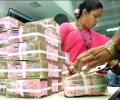
The Damodaran committee appointed by the Reserve Bank of India (RBI) to revisit the issue of banks' customer services is likely to recommend capping on service charges to small borrowers or vulnerable sections of society.

rediffGURU Sunil Lala answers your personal finance-related queries.

rediffGURU Jinal Mehta answers readers' financial planning and health insurance queries

Nikunj Saraf, Vice President Choice Wealth, answers your queries.

'If weak indicators persist, there is a risk that India could slip into a prolonged slowdown similar to the one experienced between 2014 and 2019,' warns Debashis Basu.


Cash trading volume declined in 2022, even as benchmark indices outperformed their peers. The average daily trading volume (ADTV) for the cash segment fell 18 per cent year-on-year to Rs 61,392 crore (NSE and BSE combined). The ADTV for the futures and options (F&O) segment (NSE and BSE combined) stood at Rs 125 trillion (notional turnover), up 117 per cent from the previous year.
 © 2026 Rediff.com - Advertise with us - Disclaimer - Privacy Policy - Sitemap - Feedback - About us - Terms of use - Grievances